
How Much Payload Do You Lose When You Mount a Piggyback?
How Much Payload Do You Lose When You Mount a Piggyback?
.jpg)
How much payload do you lose when you mount a Piggyback? On a typical Class 7 flatbed, roughly 40%. The exact number depends on the model you mount and the truck you mount it on, but the math that finds it works the same everywhere. The stranger part is that the number appears on no paper you'll touch during the purchase. The forklift spec sheet tells you what the machine lifts. The door sticker tells you what the truck can legally weigh. The 7,100 lbs. sitting between those two documents stays out of sight until the truck crosses a scale with a load it was never legal to carry.
The math below puts that number in front of you while it's still cheap to act on. You'll see where the weight comes from, what it presses against, and how the right body puts some of it back.
The Forklift Weighs More Than It Lifts
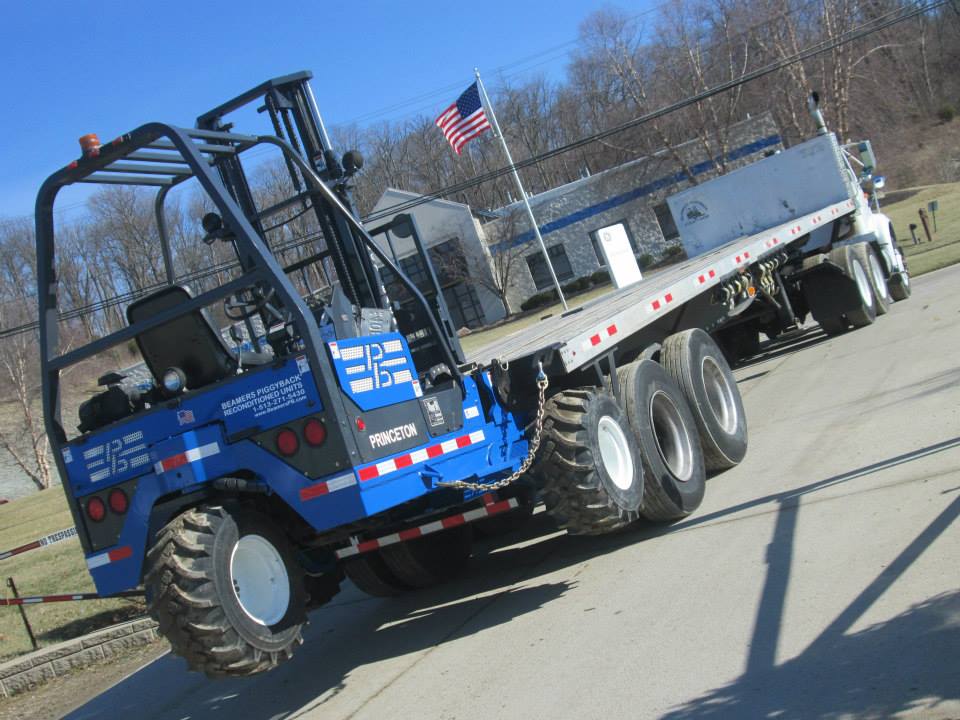
The spec sheet leads with lift capacity, but that's not the number you subtract from your payload. A Princeton PB55.3 is rated to lift 5,500 lbs. The machine itself weighs 6,570 lbs. unloaded. So the answer to "how much can a forklift lift" and the answer to "how much does a forklift weigh" are two different numbers, and the second one is bigger.
Then the mounting hardware joins the total. The OEM kit adds roughly 500 lbs. of steel before the machine ever hooks on. Princeton publishes truck and trailer requirements for exactly this reason. Add machine and kit together, and total truck-mounted forklift weight lands around 7,100 lbs. of dead weight on the chassis. Mast extensions and optional equipment push that higher still. Most heavy duty forklifts follow the same pattern: the machine outweighs its own rating.
The Three Numbers That Decide What You Can Haul
Once you know the weight, the question becomes what it counts against. Three ratings decide that.
Gross vehicle weight rating, or GVWR, is the maximum load the whole truck can legally weigh. That covers everything on it: body, fuel, driver, equipment, and cargo. Axle ratings, listed as GAWR, work the same way for each axle group. The front axle has its own limit, and so does the rear. Usable payload is what's left over. Subtract the truck, the body, the fuel, the driver, the kit, and the forklift from the GVWR. Whatever remains is the cargo you can haul.
But here's the trap inside those definitions. A Piggyback hangs off the back of the truck, so it levers weight onto the rear axle and lifts weight off the steer axle. That means a truck can sit under its GVWR and still run an illegal rear axle. If the numbers work on paper but the weight distribution is wrong, the truck still fails.
The Math on a Real Truck
So let's run the full subtraction on a setup you could buy today. The payload calculation works the same way on any truck once the curb weights are known.
Start with a Class 7 single-rear-axle flatbed rated at 33,000 lbs. GVWR. The bare chassis with a full diesel tank and a driver weighs 13,500 lbs., which leaves 19,500 lbs. of rating. A standard steel flatbed body takes 2,000 lbs. more, and now 17,500 lbs. remain. That 17,500 is the truck's payload without a forklift, and it's the number the route was probably planned around.
Once the machine is mounted, the PB55.3 and its kit take 7,100 lbs. together, and the remaining legal payload lands at 10,400 lbs. Compare the two numbers: 17,500 without the forklift, 10,400 with it. The Piggyback costs this truck 40.5% of its usable payload, and that share holds close on most trucks in this class. Run the same subtraction on your own chassis, body, and machine weights, and you'll have your number before you sign anything.
What Happens When the Math Gets Skipped
Skip the math, and the scale finds it for you. In Ohio, the fine schedule under ORC 5577.99 escalates with the overload. It starts at a flat $80 for the first 2,000 lbs. over. By 10,000 lbs. over, it reaches $160 plus $3 per every 100 lbs., with jail time on the table.
When the violation is on an axle instead of the gross weight, it's harder to talk your way out of. Ohio only forgives an axle overload under 1,000 lbs., and only when the neighboring axle is underloaded by at least that much. A driver can slide pallets forward to fix that. A bolted-on forklift doesn't slide. The machine also extends the truck's rear overhang, which runs into federal and state limits on length. And a fine is the smaller problem. An out-of-service order parks the truck and the load right where the inspection happened.
How the Right Body Gets Payload Back
The forklift weight is fixed. The body weight is a choice, and it's the one line in the subtraction you control.
Aluminum weighs roughly one third what steel weighs. Build an identical flatbed out of it, and total body weight drops 40 to 45%. On the worked example above, that puts hundreds of pounds back into legal load capacity. Every pound the body doesn't weigh is a pound of cargo the truck can haul.
The trade between steel and aluminum runs both directions, so weigh it honestly. Steel costs less upfront and takes hard impacts better. Aluminum costs 20 to 30% more upfront, but it resists rust and road salt, and it holds resale value. Deck length is part of the same equation. A longer deck restores cargo space, but the added structure has its own weight. Placing loads toward the cab offsets the forklift's rearward leverage. Because every body built through Beamer's Truck Bodies is a custom build, the deck gets spec'd to the exact truck and machine it will carry.
Spec the Whole System with Beamer's Piggyback
Every figure in that math came from one of three places: the truck, the body, or the forklift. Buy those from three different sellers and the subtraction becomes your job, because each shop only knows the weight of its own piece. A dealer can quote a chassis down to the pound and still have no idea what your finished truck will legally haul.
At Beamer's, all three pieces come through one door. We sell new and used Princeton PiggyBacks® and build the body in-house through Beamer's Truck Bodies. Our team installs the OEM Princeton mounting kit too. So the weight math gets run before you spend a dollar. If you already bought the pieces separately, bring us the setup and we'll run the numbers on what you have. Either way, a machine that takes 40% of your payload is worth an hour of math before any money moves.
Contact our team to spec your truck, body, and Piggyback as one system.